Octant intrusion detection

Intrusion detection that can't be quietly defeated.

Octant is an intrusion detection system whose field panel, firmware and head end are designed together. Every alarm is authenticated, no acknowledged alarm is lost, and a power cut reports itself.

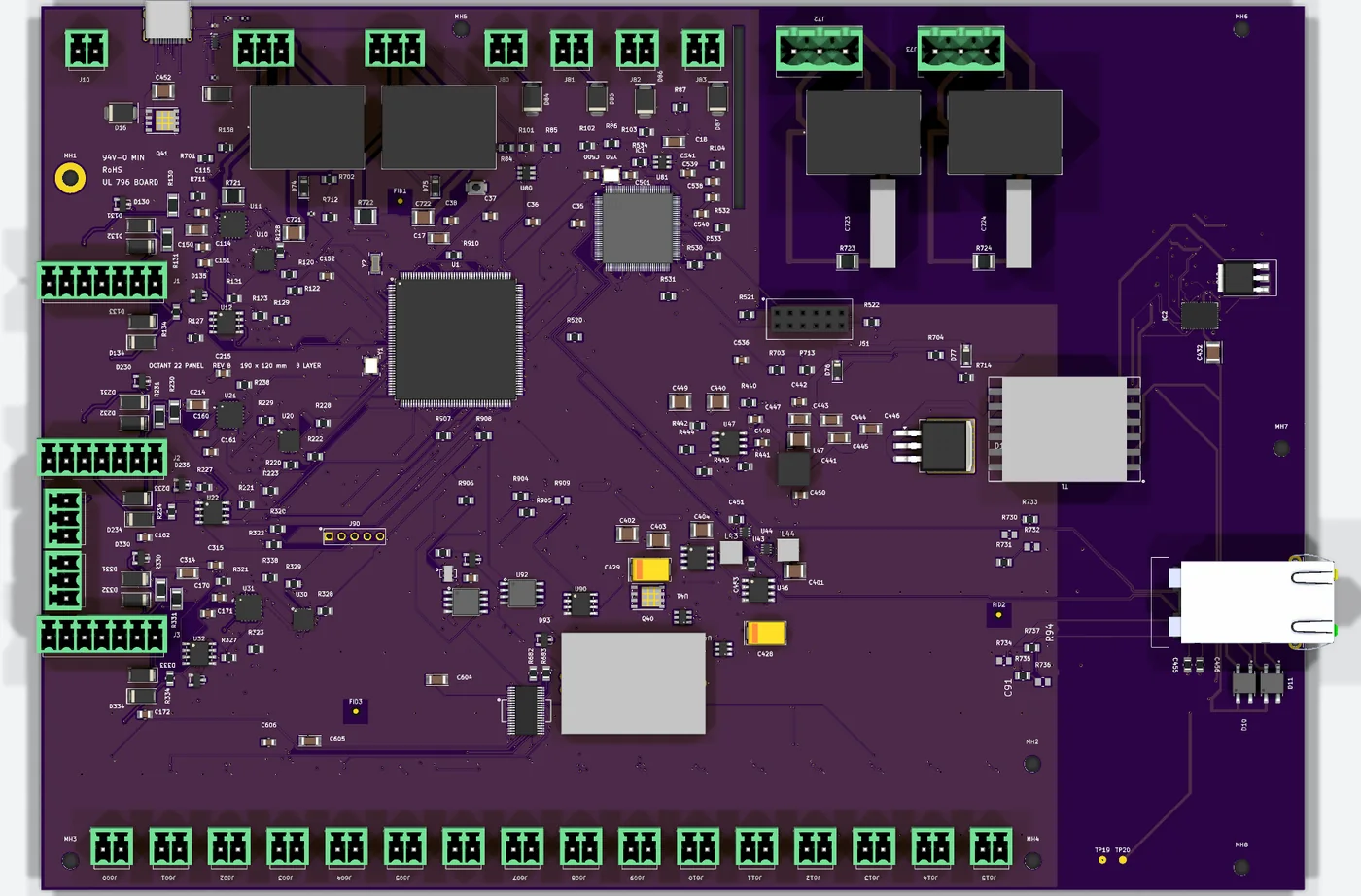
Rendered view of the Octant 22 Panel: a purple circuit board with the microcontroller at center, terminal blocks along the edges and the Ethernet jack.
DrawingOctant 22 Panel
Layers8
Solder maskPurple
StatusDesign complete

The gap

Most systems prove a wire is intact. We prove the alarm arrived.

Conventional panels supervise the loop out to each sensor. The path from the panel to the monitoring station is where a replayed, suppressed or spoofed message, or a well-timed power cut, can blind a site without raising an alarm. We treat that path as part of the protected system.

Replay and spoofing

Every message is authenticated and counted

Each frame carries an authentication tag and a sequence number inside a replay window. Five forged frames in 60 seconds raise a link-tamper alarm.

Suppression

Silence is an alarm

Every panel sends an authenticated supervision heartbeat. If the head end goes quiet for 3 seconds, the panel moves to a standby head end.

Power cuts

The panel reports its own power loss

An analog power-fail circuit logs the event and sends a final authenticated message while the supply is still holding up.

The system

Octant is three parts, designed together

One team wrote the panel hardware, the firmware, the server and the operator console, so the guarantees hold from the sensor loop to the operator's screen.

Octant 22 Panel

Supervised inputs, readers and outputs

  • STM32H573 microcontroller with Arm TrustZone
  • 16 zones with six-state loop decoding, plus enclosure tamper, temperature, supply status and reader tampers (22 supervised inputs)
  • 8 outputs: 4 relays and 4 solid-state
  • 3 reader and keypad ports, OSDP Secure Channel or Wiegand
  • Power over Ethernet (802.3at) or 12 to 24 volts DC
  • Copper Ethernet and a fiber-module port
  • Event log in non-volatile F-RAM that survives power loss
Head end

A service on the servers you already run

  • Windows Server service with a PostgreSQL database
  • Hot standby: a new leader takes over in 0.1 to 0.3 seconds
  • At-least-once event delivery with duplicate removal
  • Tamper-evident, HMAC-chained audit trail
  • Syslog and CEF forwarding over TLS to your SIEM
  • Signed firmware distribution to panels
  • Read-only REST API and signed webhooks
Octant Control Center

Built around the alarm, start to finish

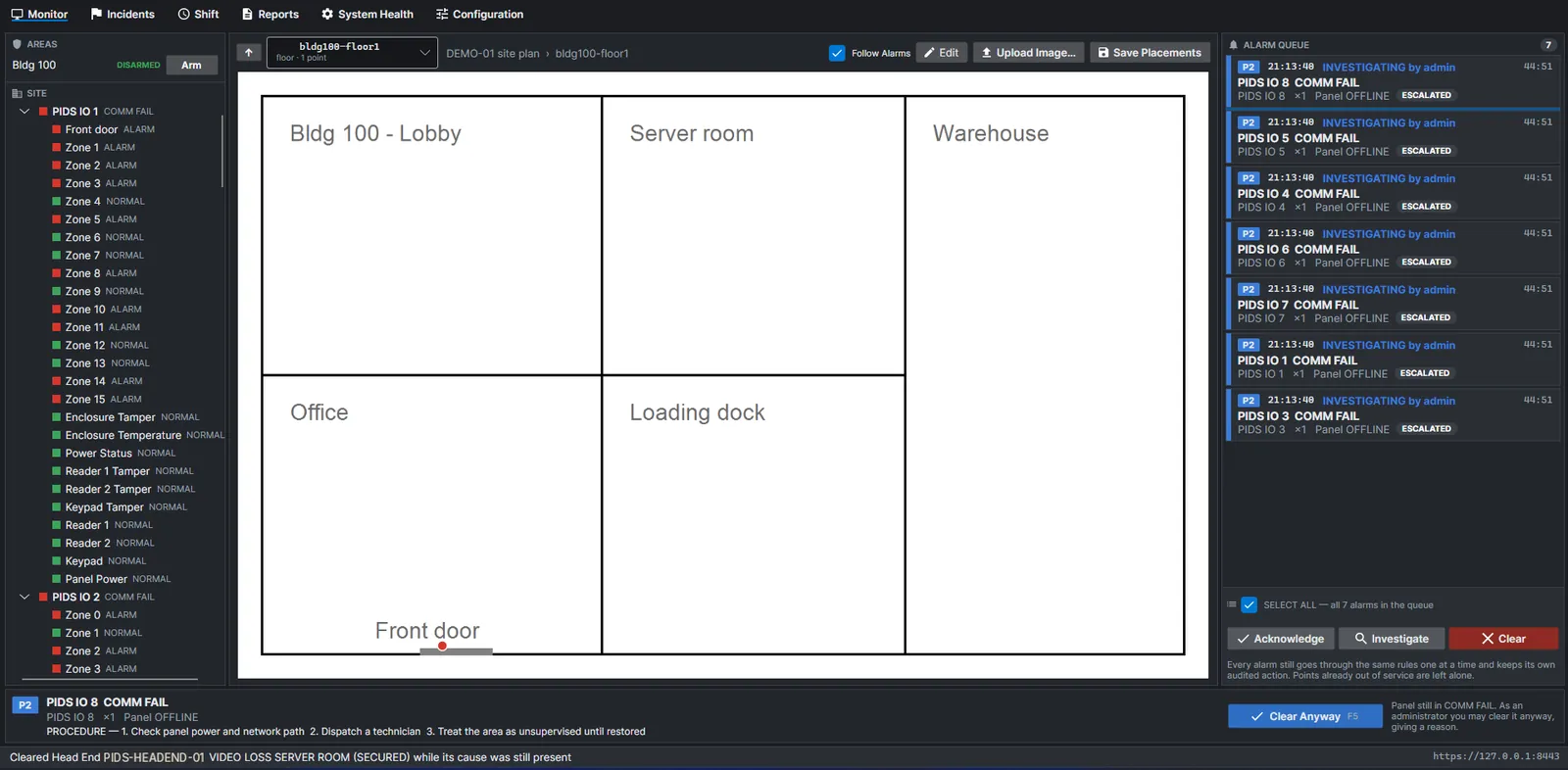
  • Map-based alarm monitor with a live alarm queue
  • Acknowledge, investigate and clear, with the site's procedure on screen
  • Shift handover and incident reports
  • Role-based permissions and partitions
  • Sign-in with Windows, smart card or an authenticator app
  • Self-test that reports its own configuration faults
Operator console alarm monitor: a site plan in the center, zone status list on the left and an alarm queue on the right with communication-failure alarms under investigation.

Octant Control Center on a demonstration site (pre-release build). Panels that stop reporting are raised as alarms, each with its procedure attached.

Six loop states, decided at the panel

Each zone is read against its end-of-line resistors (1k, 2k or 5k ohm packs), so the panel tells a real alarm from a cut wire or a bypass attempt before anything leaves the enclosure.

Loop stateWhat the panel reports
NormalLoop at its end-of-line value
AlarmThe sensor has tripped
TamperThe sensor's tamper switch has opened
Alarm plus tamperBoth at once
CutOpen circuit: the loop has been cut
ShortShorted loop: an attempt to bypass the sensor

Measured on silicon

What happens when the power is cut

Timed on the Octant 22 Panel firmware running on STM32H5 development hardware, from the moment the supply rail starts to fall.

  1. 0Supply rail begins to fall
  2. 286 µsPower failure logged to non-volatile memory
  3. 667 µsFinal authenticated message handed to the network
  4. 22 msHead end acknowledges it

Steps are in order, not to scale. µs is microseconds and ms is milliseconds. In simulation, the panel and network use 15.7 milliseconds of a 6-second annunciation budget, and head-end latency under burst load stays between 0.18 and 0.26 seconds at the 99th percentile.

Security

Built for the security review, not patched for it

The controls an assessor asks about are part of the design: validated cryptography, strong sign-in, an audit trail that shows tampering, and logs that flow to the tools your security team already watches.

Validated cryptography

The head end does its cryptography through Windows CNG, the FIPS 140-3 validated module in Windows Server 2022. The next panel revision adds a FIPS 140-3 Level 3 secure element.

An authenticated, encrypted link

AES-256-GCM with per-session keys derived by HKDF, deterministic nonces, a replay window and a fresh key every 24 hours.

Signed firmware and secure boot

Panel firmware is signed, checked at every boot and delivered from the head end, so only images you approved run in the field.

An audit trail that shows tampering

Every operator action is written to an HMAC-chained log. A deleted or altered entry breaks the chain.

Strong sign-in, no local accounts

Operators sign in with Windows, a smart card or an authenticator app, and see only the partitions their role allows.

Logs where your team looks

Syslog and CEF over TLS to your SIEM. The head end also checks its own security settings and raises a health alarm when one is wrong.

Where it fits

Octant is built for sites where the alarm system itself gets inspected

High-security facilities

Protected areas and entry points where the detection system has to pass its own review, not just the sensors on it.

Secure rooms and vaults

Keypad arming at the door, a supervised enclosure tamper, and documentation written for assessors.

Critical infrastructure

Utilities, water and telecom sites with long fiber runs, no IT closet and nobody on site.

Data centers and commercial

Supervised inputs and OSDP readers with open interfaces, without buying into a proprietary head end.

Status

Where we are today

We would rather tell you exactly how far along we are. The software is working; the hardware is designed and its first build is next.

  1. Complete

    Head end and operator console

    Built and running, with 494 automated tests and 27 bench scenarios passing. An internal adversarial review found 12 issues, all fixed.

  2. Complete

    Panel firmware on real silicon

    Zephyr RTOS firmware runs the encrypted link, command path, independent watchdog and power-fail path on STM32H5 hardware.

  3. Complete

    Revision B board design

    8-layer design complete and passing its design-rule checks.

  4. Next

    First board build

    Fabricate and bring up the first Octant 22 Panels (revision B), measure hold-up energy at worst-case load and temperature, and move link cryptography into the secure element.

  5. Planned

    Proof and listing

    Model-check the transport protocol, run independent red-team testing, and pursue UL 294 and UL 2050 listing. No listings are held yet.

Looking for pilot sites, integrator partners and research partners. If you run a site that has to prove its detection system works, we would like to hear from you.

Get in touch

Company

About Eight November

Eight November LLC, founded in 2026, builds high-assurance physical security products. Its first product is Octant. The Octant 22 Panel, its firmware, the head end and the Octant Control Center are all designed in-house.

The founder has more than a decade of frontline security experience and works as a network engineer who designs networks and programs and integrates access control systems. He holds a B.S. in Cybersecurity and Information Systems.

The system comes from both sides of the job: the person who depends on the alarm in the field, and the person who installs, networks and supports the system behind it.

Contact

Talk to us

Integrators, facility security teams, pilot sites and research partners interested in Octant: send a note and the founder will reply.